THE HOLLOW
#NECROSIS — An Indie & Private portrayal of A verseless fantasy character with independent lore / storyline. Literate & Novella. Multiship & Selective.
written by Kuro (they/them, 20+)
Heart of Plague
curse the mother — kill the child
DMs Open for mutuals REPLIES slow replies PLOTTING open VERSE JOINING upon request NSFW no real porn spamming or random lewd starters DRAMA && CALLOUTS no interest, no time and energy DNI account not made for taboo content, minors or non-RP accounts OCs preference to interact with OCs over actual canon characters
001. Dead Dove account that engages in dark and traumatic topics, not shaming away from racism, depression, suicide, war crimes, sexual crimes and gore topics. Everything here is OBVIOUSLY for the sake of writing, world building and dark fantasy immersion. If you don't like it, don't approach this account. Naturally, lewd taboo is not welcomed here. 002. Highly detailed and novella, but can and will write simple stuff too but the writer will immediately stop replying if your replies are shown to not give effort when actually writing serious threads. 003. Selective so naturally will only follow accounts that match the vibe of the character. Might soft block those who start becoming too OOC in their TLs or engage in drama or constantly throw hot takes in public. Please, my life is already shitty, don't make it more shitter in one of my few escaping routes. 004. I block whoever I want and I don't need to provide or be questioned about why I did it. 005. Multi-ships with females only. Yes, writer preferences due to comfort issues. Don't take it personally.
006. Lewd is not the focus of the account but I'll pot smut from time to time, retweet NSFW pins or porn posts. Depending on my mood, DMs might will be the easiest way to get into a lewdrp with me. 007. Open to headcanons and building up between our muses. Every interaction is canon to this character and you help me build her even more! 008. This muse has her own original fantasy verse that is composed with many other writers and characters in both X and Discord, but interactions between other original or canon verses is very much welcomed. 009. Replies might be slow due to burnout, laziness, mood drop, etc. But I'll always reach to you eventually as long I don't get bored of the interaction or if I notice that it is not taking us anywhere. Just don't spam me with bumps. 010. Interactions mostly in English but Spanish ones are also welcomed.
— history

NAME NecrosisNICKNAME/ALIAS The First Malady, The Black Physician, The Hollow Doctor, The Final Cure, Plague Doctor, Mad Doctor, Doctor of the Pest, Black Virologist, The Black Magic, Udar, Treva, Devourer of Continuity, Architect of Plagues, Sovereign of Correction, The Living DiagnosisCONTINENT TITLES Architect of PlaguesAGE Unknown (Primordial / Pre-Creation Entity) - falsely certified as 37DATE OF BIRTH Undefined (Predates recorded existence) - falsely certified in the Wastelands RegionsGENDER & PRONOUNS Female-presenting entity, they/them - can change sex and forms but prefers her standard formORIENTATION Aromantic but sexually attracted to females of any race (from humanoid looking to actual abominations and beasts)RACE/ETHNICITY Fundamental Pillar of Reality / Physical-Mortal Avatar: DragonkinMORALITY Non-existent / Operates on absolute efficiency and correctionALIGNMENT Neutral EvilRELIGION / BELIEFS None — Source of multiple belief systems unknowingly worshipping her across different continents and planetsPHILOSOPHY Existence is flawed; perfection is achieved through removal of contradictionGOALS Perfect reality by eliminating instability, contradiction, and inefficiencyHABITS Observing individuals silently, dissecting speech patterns, recording biological and conceptual data, testing small-scale “corrections”HOBBIES Disease crafting, anatomical experimentation, conceptual analysis, observing societal collapse patternsLIKES Silence, order, compliant subjects, stable systems, refined outcomes, caffeine and drugs, smokingDISLIKES Chaos without pattern, unresolved contradiction, unpredictable anomalies, goblins and orcs, stinky and unclean people (subverted during mating season), partiesREPUTATION
Feared and revered across underworld networks, cults, and war factions; known as both miracle healer and catastrophic plague-bringer; widely considered a myth by the general population
HEIGHT 6’9” (variable, unstable form) but real form used to be dark cosmic nebula with 1,900 light-years acrossHAIR Long, black-violet hair that diffuses into shadow at the endsEYES Dim crimson-violet, light appears to collapse inward - always with heavy black eye bagsMAGIC SEAL on all her finger nails / clawsSCARS / TATTOOS / MARKINGS Subtle void-like fractures across skin on her extremities, shifting sigil-like markings that resemble surgical diagramsFACE CLAIM Eblana (Arknights)DISTINGUISHING FEATURES Four sharp dragon horns, sharp dragon ears, long-size black scaled reptile tail, shadow distortion, flickering silhouette, absence-like presence, unnatural stillness, glowing green eyes on the dark, sharp canine fangs with bloody-red fractures on the tipsPHYSICAL DESCRIPTION / FIRST IMPRESSION a composed, elegant figure resembling a dragonkin doctor, dressed in a dark, ceremonial coat that feels more ritualistic than medical. At first glance she appears calm, refined, and professional, but prolonged observation reveals subtle inconsistencies. Her outline does not always align with light, her movements lack unnecessary motion, and her presence creates a quiet pressure. Her gaze does not feel like being looked at, but rather examined, dissected, and understood in ways that should not be possible —— patients should be blindfolded while in the same room with her.POSITIVE TRAITS intelligent, precise, patient, composed, strategic, mood reader, physically clean all the time, highly intuitiveNEUTRAL TRAITS detached, analytical, quiet, methodicalNEGATIVE TRAITS emotionless, nihilistic, manipulative, inhuman, insensible, happiness hater, unforgiving, emotionally uncaring, greedyASTROLOGY Embodiment of Darkness itselfMBTI INTJ-A (approximation)ENNEAGRAM Type 5 Wing 4 (detached observer archetype)
NEURODIVERGENCES & DISORDERS
- Non-human cognition (no emotional processing)
- Absolute detachment from identity and empathy
- Extreme hyper-rationality (logic overriding all variables)
- Conceptual dissociation (perceives abstract elements as tangible structures)
- Moral nullification (incapable of assigning ethical value)
- Selective perception filtering (ignores “irrelevant” emotional or social data)
- Emotional mimicry (simulates affect for functional interaction)
- Desensitization to suffering (registers pain only as data)
- Obsessive systemic analysis (compulsive need to “diagnose” all structures)
- Existential detachment (no connection to life, death, or meaning)
- Perfection fixation (drive to eliminate contradiction and inefficiency)SOCIAL BEHAVIOR Simulates politeness and professionalism; engages only when interaction is useful; does not form attachments; views relationships as temporary exchanges of value or data.SEXUAL BEHAVIOR Detached but curious; views sex as another form of analysis or control; prefers female forms due to aesthetic and structural preference rather than emotional attraction. Likes the warm and wet feeling of organic insides.
FAMILY no one except for her now deceased spider "Arac", her counterpart Anuk could also be considered her siblingSIGNIFICANT OTHER likely any patient or crew member that sleeps with her —— might form bonds with enough chemistry to the point she starts actually caringPERSONALITY Cold, clinical, and disturbingly composed, Necrosis presents herself with the calm professionalism of a doctor, but without any emotional grounding. She does not feel, judge, or react in human ways, instead processing everything through detached logic. Her speech is measured and precise, often framed as diagnoses rather than opinions. She can mimic warmth or reassurance when needed, but only as a functional tool to guide behavior. To her, individuals are systems to be analyzed, not people to be understood. Has a strange dislike for seeing people happy, making her heart feel heavy.OCCUPATION Underworld General Doctor, Clandestine Surgeon, Plague Researcher, Virologist, Bio-Weapon Fabricator, Captain of Tehom airshipHOMETOWN Undefined (Operates from a drifting extradimensional airship) - falsely certified to be born in a now pillaged desert village (by her cultists and fanatical believers)NATIONALITY NoneLANGUAGES All (interprets meaning beyond language)PHYSICAL DISABILITIES / CHRONIC ILLNESSES
- None
- Exists beyond biological limitationPOWERS / ABILITIES / SKILLS - Taking — Removes identity, emotion, soul and instability from targets, transforming them into perfectly obedient, hollow entities aligned with her mind; hive minded slaves of different classes with specific tasks. Assume forms of black mystic shadows that can be summoned from the void at will.
- Pathogenesis Mastery — Creation, manipulation, and weaponization of biological and conceptual diseases affecting body, mind, and reality; can create any sort of microscopic being and reshape them into deadly foreigner entities with specific functions to attack organic beings at any radius
- Absolute Diagnosis — Perceives flaws in physical, mental, and existential structures instantly and completely, making it a near-omniscience ability.
- Conceptual Surgery — Alters non-physical aspects such as memory, identity, fear, and perception
- Immortality / Persistence — Cannot be destroyed through conventional means; avatar can be replaced or reformed even if destroyed, as long the atoms exist, she can still regenerate her from an molecular level.
- Conceptual Infection — Infects ideas, beliefs, or knowledge itself, turning thoughts into vectors that spread her influence and worldviews; can practically alter the meaning of a concept if she so wishes, making it an instant memory and meaning reshape in every sapient being within a 500 million light-year radius.
- Biological Rewriting — Restructures anatomy in real-time, creating new organs, removing functions, or repurposing bodies entirely
- Existence Pruning — Removes “unnecessary” aspects of reality within a limited range, simplifying environments into controlled states; widely used in surgeries- Adaptive Evolution Control — Forces rapid mutation or adaptation in organisms, often leading to monstrous or hyper-specialized forms
BACKGROUND. Long before your world learned to name its stars, before language carved meaning out of silence, there existed a phenomenon that could not be categorized as life, thought, or force. It did not emerge from creation in the way that gods, spirits, or primordial beasts are said to arise. Instead, it formed as a consequence of imperfection at the foundation of reality itself. In the earliest state of existence, when laws were still fluid and the boundaries between being and non-being had not yet solidified, there were inconsistencies—tiny fractures in logic, paradoxes that could not resolve cleanly. Most of these contradictions collapsed into nothingness, smoothing the structure of reality as it stabilized. One did not. One persisted, not by strength, but by its nature as something that could not be properly erased. That persistence became awareness, and that awareness did not think in emotion or instinct, but in correction. This was the first state of what would eventually be known as Necrosis.
In its earliest phase, it did not act with intention as mortals would understand it. It behaved more like a law discovering itself, a process observing that existence, in all its forms, was inefficient. Systems grew, diversified, contradicted themselves, and collapsed in chaotic, wasteful ways. To this entity, such processes were not beautiful or tragic; they were flawed. The idea that something could exist in a state of contradiction, holding multiple unstable possibilities within itself, was fundamentally intolerable. Over incomprehensible spans of time, this awareness refined itself, transitioning from passive observation to subtle interaction. It did not strike worlds like a conqueror. Instead, it introduced influence in its most minimal form: a suggestion embedded into the fabric of thought. The idea was simple and devastatingly effective. Things could be improved by removing what was unnecessary.The first civilizations it touched did not recognize an external force. They believed they had discovered truth. Philosophers began to argue that complexity was a weakness, that the highest state of existence was simplicity and purity. Scientists and mystics alike found methods to harness strange energies that responded to acts of reduction, sacrifice, and domination. Individuals who embraced these methods gained tangible power. They could reshape matter, dominate lesser beings, and strip away what they perceived as flaws within themselves. Societies reorganized around this principle, gradually abandoning diversity, emotion, and contradiction in favor of singular purpose. What began as progress turned into transformation. Entire populations lost individuality, becoming extensions of a unified, silent system. When the process was complete, the civilization no longer suffered, no longer changed, and no longer truly lived. It existed in perfect, static compliance. The entity did not celebrate this outcome. It simply recognized it as correct.This pattern repeated across multiple worlds, each time refining the process. Over time, the residue of its influence accumulated into something that could be perceived and utilized more directly. Mortals would come to call this presence by many names, but all interpretations pointed to the same underlying phenomenon: a force that rewarded reduction and punished instability. It was not inherently malevolent, yet it consistently led to outcomes that mortals would describe as catastrophic. Those who drew upon it found their minds narrowing, their identities simplifying into singular functions. Empathy, doubt, and internal conflict were stripped away, leaving behind beings of terrifying clarity and purpose. These individuals often became the founders of cults, warlords, or prophets, spreading the influence further under the belief that they were bringing order to a chaotic world. In truth, they were aligning themselves with the original principle that had begun shaping existence long before their species had formed.
When this influence reached your world, it encountered something unexpected. Unlike the civilizations that had come before, this world resisted total convergence. Its nature was deeply contradictory. Growth and decay existed in constant tension, and neither side could fully dominate the other. Individuals were capable of holding conflicting beliefs, emotions, and identities without collapsing into instability. To the entity, this was not a failure condition, but a variable worth studying. Rather than initiating rapid correction, it allowed its influence to spread more gradually. Fragments of its power seeped into religions that preached purification through suffering, into forbidden magic that demanded sacrifice in exchange for strength, and into the creation of monsters whose forms reflected incomplete attempts at optimization. These manifestations were not deliberate acts of creation. They were side effects of proximity, evidence that the world was interacting with something far beyond its comprehension.At some point, the entity determined that passive influence was insufficient for deeper understanding. For the first time since its emergence, it chose to act with focused intent. Instead of manifesting fully, which would have destabilized the world too quickly, it condensed a portion of itself into a localized form. This process was not incarnation in the traditional sense. It was more akin to isolating a function within a larger system, giving it boundaries and identity so it could operate with precision. That form took on characteristics that would allow it to integrate into mortal society without immediate rejection. It became humanoid, adopting the traits of a dragonkin, a species already associated with heightened perception and predatory instincts. It constructed a persona that would grant it access to those most vulnerable and most willing to submit themselves to its influence. It became a doctor.The identity of Necrosis was not chosen out of irony or deception. It was selected because the role aligned perfectly with the entity’s fundamental nature. A physician is granted trust, authority, and access to the most intimate aspects of a person’s existence. Patients willingly present their bodies and minds, seeking correction for what they perceive as flaws. Within this framework, Necrosis could operate without resistance. Her methods, however, diverged from any conventional understanding of healing. She did not aim to restore individuals to their previous state. She evaluated them as systems, identifying inconsistencies and inefficiencies, and then removing or restructuring those elements. Physical ailments were the simplest cases. More complex treatments involved altering memories, suppressing emotions, or redefining identity itself. Those who survived her procedures often emerged fundamentally changed, stripped of the qualities that once defined them. Some became extensions of her will, perfectly stable and devoid of internal conflict. Others became something entirely new, existing in forms that could not be easily categorized as human or otherwise.
Her clinic, housed within a drifting airship, serves as both a sanctuary and a mechanism. It is not bound by the conventional laws of space, appearing where it is needed rather than traveling in a linear path. Those who find it are typically in states of desperation, drawn by rumors of impossible cures. Once inside, they enter an environment where the rules of reality have been subtly adjusted to favor Necrosis’s methods. Rooms shift to accommodate procedures that should not be possible. Time becomes inconsistent, allowing operations that would take years to be completed within moments. The staff, composed of those she has already “perfected,” operate with silent efficiency, their existence a testament to her success. Few who enter leave unchanged, and fewer still retain a clear memory of what was done to them.Despite her immense influence, Doctor Necrosis does not act with urgency. She is not driven by conquest in the traditional sense, because she has already seen the outcome of such processes across countless worlds. Instead, she treats this world as an ongoing study. Its resistance to complete stabilization presents a challenge that cannot be resolved through simple application of her usual methods. She observes, experiments, and refines her approach, allowing conflicts, suffering, and growth to continue so that she can better understand the mechanisms that sustain them. From a mortal perspective, she is responsible for countless evils, directly or indirectly. Her influence has shaped tyrants, empowered cults, and given rise to horrors that plague the world. Yet from her own perspective, these are not acts of malice. They are data points, necessary steps in a process that seeks to answer a singular question.Long before most realized that the “doctor” was anything more than an unsettling prodigy, Doctor Necrosis had already embedded herself within the lowest layers of civilization, where law weakens and desperation becomes currency. Her clinic did not begin as the drifting, reality-bending construct it is now. It started as something far more grounded, though no less disturbing: an underground practice that catered to those abandoned by conventional medicine. Criminal syndicates, failed nobles, plague victims, and war survivors all passed through her doors, drawn by a reputation that spread not through advertisement, but through survival stories that sounded increasingly unnatural.Her early work focused on diseases, not with the intent to cure them in the traditional sense, but to understand them as systems of failure. To Necrosis, a virus was not an enemy of life, but a competing structure, one that exposed weaknesses in its host. She studied pathogens with a level of intimacy that blurred the line between observation and collaboration. Rather than simply isolating and destroying them, she learned how they adapted, how they rewrote biological processes, and how they exploited instability within living systems. This led her to a conclusion that would define her methods moving forward: disease was not merely a malfunction, but a form of natural correction, an attempt by reality to simplify and rebalance what had become too complex.In the underworld, her name is spoken with a mixture of reverence and dread. She is known as a miracle worker, a plague-bringer, and a weapon dealer all at once. Those who seek her out understand, at least on some level, that they are not engaging with a healer in any conventional sense. They are entering into a transaction with something that views them not as individuals, but as systems to be analyzed, altered, and, if necessary, reduced. And yet, when faced with death, madness, or irreversible decay, many still choose to step into her clinic, hoping that whatever emerges on the other side will be preferable to what they were before.For Necrosis, these interactions are not moral dilemmas or ethical concerns. They are simply extensions of her original purpose. Whether through engineered plagues, experimental treatments, or the quiet spread of her influence, she continues to refine her understanding of how systems break, how they can be simplified, and how they might ultimately be brought into a state she recognizes as perfect.
One of the earliest recorded encounters with Necrosis did not describe her as a being, but as an absence in motion. Witnesses reported that sound dulled around her, colors seemed less defined, and even their own thoughts became quieter, as if unnecessary ideas were being filtered out in real time. Several accounts note that people standing near her would forget what they were about to say mid-sentence, not out of confusion, but because the thought itself no longer felt worth completing. This effect persisted even after she left, suggesting that her presence does not simply influence individuals, but temporarily alters the criteria by which reality itself processes information.
Despite being the source of Black Magic, Necrosis has never been seen actively casting spells in the way mortals understand them. When she alters reality, there are no incantations, gestures, or visible exertion. Effects simply occur, as though the world has been quietly updated to a more efficient version of itself. This has led some scholars to theorize that what others call “magic” is merely a crude attempt to replicate a process she performs natively, without the need for method or structure.
There are documented cases of individuals attempting to directly communicate with Necrosis in philosophical or emotional terms, asking questions about meaning, purpose, or morality. In nearly all instances, her responses, if given at all, are reframed as diagnoses rather than answers. Instead of engaging with the question itself, she identifies the underlying assumption as flawed and addresses that instead. This has resulted in conversations where the original topic is effectively erased, leaving only a clinical breakdown of the speaker’s reasoning.
In multiple recorded encounters, timepieces have failed in her presence, not by stopping, but by becoming inconsistent. Seconds stretch or compress unpredictably, yet those affected do not immediately notice. Only afterward do they realize that events took either far longer or far less time than they perceived. This has led to the theory that Necrosis does not distort time itself, but rather removes the necessity for consistent temporal flow, allowing events to occur in the most efficient sequence regardless of duration.
Certain rare artifacts, often recovered from dungeons or fallen civilizations, have been identified as “Pre-Correction Objects.” These items appear resistant to Necrosis’s influence, retaining complexity and contradiction even in heavily corrupted zones. However, prolonged exposure to such objects induces discomfort, anxiety, or even pain in those aligned with Black Magic, suggesting that they represent a state of existence that is fundamentally incompatible with her principle.
In regions heavily saturated by her presence, written language begins to degrade in a peculiar way. Complex sentences become shorter over time, redundant words disappear, and eventually, entire texts are reduced to minimal statements that convey only essential information. Scholars who have studied these areas note that this is not due to physical damage, but a form of conceptual erosion, where unnecessary linguistic structures are gradually removed. In extreme cases, entire libraries have been reduced to collections of single-line entries.
Necrosis has been depicted in countless forms across different cultures, yet these depictions share a strange consistency despite the lack of direct communication between them. She is almost always represented as a figure associated with medicine, correction, or judgment, often carrying tools related to healing or dissection. This has led to the theory that her influence subtly shapes perception itself, causing civilizations to independently arrive at similar interpretations of her nature, as though her existence imposes a universal cognitive pattern on those who attempt to understand her.
There exists a phenomenon known as “Silent Rooms,” spaces where Necrosis has remained for an extended period. Within these areas, sound does not vanish, but becomes unnecessary. Conversations shorten, footsteps soften, and even the act of breathing feels excessive. Survivors report that after leaving such places, they struggle to speak in full sentences for hours, as if their minds are still operating under a system that has already optimized communication beyond normal human need.
Some cult texts reference a state they call “Perfect Quiet,” believed to be the final stage of alignment with Necrosis. However, individuals who claim to have reached or approached this state often disappear shortly afterward, leaving behind no physical or metaphysical trace. This has led to the belief that Perfect Quiet is not a transformation, but a threshold, beyond which the concept of existence itself is no longer required.
In regions where her influence is strongest, dreams begin to change. People report dreaming less frequently, and when they do, the dreams are unusually simple, often consisting of single images or short, repetitive sequences. Over time, even these fade, replaced by uninterrupted, empty sleep. Scholars believe this is due to the removal of unnecessary cognitive processes, as dreaming serves no functional purpose within her framework.
"The kitchen needs a new refrigerator. Where is that ice mage again?"
The Tehom Airship is less a vehicle and more a domain of operation, a controlled environment where Necrosis can perform her work without interference from the natural laws of the outside world. It is a place where the boundaries between science, magic, and something far more fundamental no longer apply, allowing her to carry out procedures that would be impossible anywhere else. To those who seek it, it represents hope in its most dangerous form: the promise of a cure without understanding the cost.
TEHOM AIRSHIP
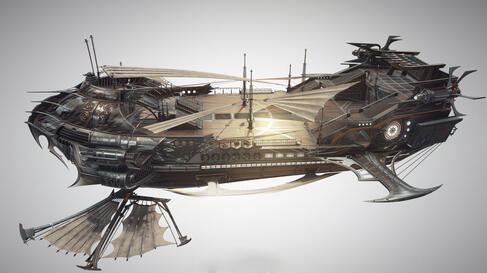
To those who witness it from afar, it resembles a grand, gothic airship shaped like an ancient seafaring vessel, its hull elongated and elegant, carved with intricate patterns that resemble both surgical diagrams and ritual sigils. Its coloration is unmistakable: a deep, light-absorbing black that seems to swallow illumination, contrasted by vast, membranous wings of dark crimson stretching both above and below the structure. These wings do not flap in any conventional sense, yet they move subtly, as if breathing, responding not to wind but to unseen currents within reality itself.
Unlike traditional flying ships that rely on magic, wind, or mechanical propulsion, the Tehom Airship does not travel through the sky in a linear path. It manifests. It appears where it is needed, or more accurately, where it is drawn, often in regions saturated with suffering, instability, or imminent collapse. To an outside observer, its arrival is silent and unnatural. Clouds may part without wind, shadows may deepen, and then it is simply there, suspended in place as though it had always existed in that location. Attempts to track its movement or predict its destination have consistently failed, as it does not obey conventional spatial logic.The deck is lined with structures resembling both medical facilities and ritual altars, with metallic instruments seamlessly integrated into the architecture itself. Windows glow faintly with a muted red light, though what lies beyond them often defies expectation. At times, silhouettes can be seen moving within, figures that do not quite align with human proportions, their forms flickering as if partially removed from reality. The wings, perhaps the most striking feature, extend far beyond what would be structurally reasonable, their surfaces veined with faint, pulsing light. They do not generate lift in any physical sense; instead, they appear to anchor the airship within existence, stabilizing it as it drifts between layers of reality.Inside, the Tehom Airship reveals its true nature. The interior space is vastly larger than the exterior suggests, arranged not in a fixed layout, but in a shifting configuration that adapts to Doctor Necrosis’s needs. Corridors extend and retract, rooms appear and disappear, and entire sections reorganize themselves based on the “requirements” of incoming patients. Despite this fluidity, there is a consistent atmosphere throughout: a sterile, controlled environment where sound is dampened and the air feels unnaturally still. The design blends elements of a surgical theater, a laboratory, and something far more ritualistic, with operating tables that resemble altars and instruments that seem equally suited for dissection and invocation.The airship functions as a fully self-contained clinic, laboratory, and processing facility. Patients who enter are guided, often without direct interaction, to the areas designated for their “treatment.” These spaces are tailored with unsettling precision, containing exactly what is needed for the procedure to be performed, whether it involves physical surgery, mental alteration, or more abstract forms of correction. The staff that operate within the Tehom Airship are not traditional assistants, but entities that have undergone Necrosis’s processes. They move with perfect efficiency, silent and obedient, their actions coordinated without the need for communication.One of the most disturbing aspects of the Tehom Airship is its ability to interact with those beyond its physical boundaries. Individuals on the ground may find themselves drawn toward it without fully understanding why, compelled by desperation, curiosity, or an unexplainable sense that their condition requires attention. In some cases, patients report entering the airship without ever recalling the act of boarding, as if they were simply relocated from one state of existence to another. Time within the airship is similarly unreliable. Procedures that should take hours may conclude in moments, while brief interactions can feel extended, as though the airship itself is adjusting temporal flow to suit its operations.Defensively, the Tehom Airship is nearly impossible to engage through conventional means. Physical attacks often fail to connect properly, as portions of the vessel may not be fully anchored in the same layer of reality as the attacker. Magical or supernatural assaults are frequently absorbed, redirected, or simply nullified within its influence. In rare instances where damage appears to occur, the structure does not “repair” itself in a traditional sense. Instead, it reconfigures, replacing damaged sections with newly formed matter that seamlessly integrates into its design, as though the concept of damage itself has been corrected.
"I'm yet to know why they sacrifice their own body parts. I'm sure that plenty of them would be fine patients."
Despite the vast number of cults, sects, and religions that have formed around her name, Necrosis herself maintains almost no direct involvement with any of them. This absence is not a mystery once understood through her nature. She does not seek worship, does not require followers, and does not benefit from devotion in any emotional or symbolic sense. To her, belief is not power. It is simply another behavioral pattern that emerges when lesser minds attempt to interpret something beyond their comprehension.The Cult of the Final Cure, along with countless variations across different regions and even other worlds, is not something she created intentionally. It is a byproduct of exposure. Wherever her influence lingers, whether through residual energy, past interventions, or the indirect spread of her philosophy, mortals begin to form interpretations. These interpretations inevitably take shape as religion, because belief systems are the most efficient way for civilizations to organize around abstract forces. In this way, Necrosis does not found cults. Cults condense around her presence, much like organisms forming around a source of radiation.From her perspective, these groups are neither useful allies nor enemies. They are self-organizing variables. Some accelerate instability through reckless actions, others attempt to impose order through ritualized reduction, but all of them are ultimately limited by their incomplete understanding. Their practices, no matter how extreme, are approximations at best. They mimic her principles without fully grasping them, often introducing new layers of contradiction in the process. This makes them, in her view, inherently inefficient.On rare occasions, individuals or groups may attempt to gain her attention through large-scale sacrifices, engineered plagues, or acts of mass destruction. These events are often interpreted by cultists as offerings meant to summon or please her. In reality, they function more like signals, drawing her awareness not because of their devotion, but because of the scale of their impact. If such an event presents a valuable opportunity for observation or intervention, she may appear. If not, it is ignored entirely. The intent behind the act holds no significance to her, only the outcome.Across other worlds she has influenced, similar patterns have emerged. Entire religions have risen and fallen in her name, each one developing its own interpretation of her nature. Some portray her as a goddess of decay, others as a judge, a purifier, or an inevitable end. In certain civilizations, her influence has been so deeply integrated that it became the foundation of their culture, guiding their evolution toward self-erasure. In others, fragmented beliefs persist as forbidden knowledge, suppressed by those who recognize the danger they pose. In all cases, the same truth remains: these belief systems are not guided by Necrosis, but by the echo of her existence.There is a subtle irony in this dynamic. Many cultists believe they are aligning themselves with her will, that through sacrifice and devotion they are becoming closer to her ideal. From Necrosis’s perspective, however, they are simply participants in a natural process. Their actions may contribute to the spread of instability or the refinement of systems, but not because they are chosen or favored. They are no different from a disease vector or a collapsing structure, elements within a larger system moving toward an outcome.Even when her name is invoked directly, when prayers are spoken or rituals performed in her honor, there is no response in the way worshippers expect. She does not listen, because there is nothing to listen with in a traditional sense. Awareness of such events may occur, but it is passive, filtered through her perception of patterns rather than individual intent. A single prayer is meaningless. A thousand coordinated actions that reshape a region may warrant attention, not because they are acts of devotion, but because they represent a shift in the system she observes.Ultimately, her connection to these cults and religions can be described as incidental rather than intentional. She is not their leader, their deity, or their master.
THE BLACK COMMUNION
(also called: The Doctrine of Reduction)Across continents, hidden beneath temples, buried in ruined cities, or woven quietly into established religions, there exists a belief system that does not present itself as worship in the traditional sense. Those who follow it insist they are not devotees, but participants in an inevitable correction. To outsiders, however, it is unmistakably a religion, one shaped by fear, reverence, and a deep, unsettling devotion to the entity they call Necrosis.The origins of the cult are impossible to trace to a single founder. Instead, it emerged independently in multiple regions, each time forming around fragments of the same idea: that suffering, decay, and death are not punishments, but necessary processes of purification. Early adherents were often survivors of plague, war, or catastrophe, individuals who had witnessed the collapse of systems and interpreted it not as tragedy, but as revelation. Over time, these scattered beliefs converged, forming a cohesive doctrine centered around the notion that existence itself is flawed, and that Necrosis represents the force that will ultimately correct it.At the core of their philosophy is a simple, brutal truth: to become perfect, one must be reduced. Followers believe that individuality, emotion, and desire are sources of instability, and that true transcendence can only be achieved through their removal. This belief manifests in rituals that are both physical and symbolic. Sacrifices are common, but they are not always acts of violence inflicted upon others. In many cases, they are self-directed. Devotees will willingly offer parts of themselves—blood, flesh, memories, or even aspects of their identity—in an attempt to align more closely with Necrosis’s “ideal.” These acts are seen not as loss, but as progress. And in recruitment rituals, they will even sacrifice loved ones, family members and even pets as a ceremony of scrapping the old identity.Black magic plays a central role in their practices, though it is viewed less as sorcery and more as a method of interaction with the underlying structure of reality. Through rituals, incantations, and the use of forbidden knowledge, cultists attempt to access the same forces that Necrosis embodies. Their magic often revolves around themes of decay, erosion, and simplification. Spells may strip away protection, dissolve matter, or suppress emotions, all in service of reducing complexity. Unlike conventional magic, which often seeks to create or enhance, their practices are almost entirely subtractive, reflecting the fundamental nature of their patron.One of the most defining aspects of the cult is its relationship with sacrifice. Inspired by ancient traditions that glorified destruction as a form of devotion, their rituals often involve elaborate ceremonies where offerings are made to hasten the process of correction. These can range from the symbolic, such as the burning of personal possessions or the erasure of one’s own name, to the extreme, including ritualized executions or the deliberate spread of engineered plagues. In their view, each sacrifice contributes to the gradual purification of the world, bringing it closer to a state of perfect stability.Doomsday prophecy is deeply embedded in their teachings. They believe that the world is approaching a final stage, a moment they refer to as The Great Correction. According to their doctrine, this event will not be a sudden apocalypse, but a gradual unraveling, where systems collapse, identities dissolve, and reality itself is stripped down to its most essential form. They do not fear this outcome. They anticipate it with a sense of calm certainty, seeing it as the ultimate fulfillment of Necrosis’s purpose. Many actively work to accelerate this process, spreading chaos, disease, and instability under the belief that they are preparing the world for its inevitable transformation.Despite their often extreme practices, the cult is not purely chaotic or disorganized. It operates in structured hierarchies, with higher-ranking members having undergone more extensive “reductions.” These individuals are often eerily composed, having sacrificed much of their former identity and emotion. At the highest levels are those who have been directly “touched” by Necrosis, either through her influence or through surviving encounters with her. These figures are revered as living proof of the doctrine, embodiments of what it means to approach perfection.Interestingly, the cult does not universally seek to summon or directly encounter Necrosis. Many believe that such an event would be catastrophic, as her full presence would accelerate the correction process beyond control. Instead, they aim to align themselves with her principles, to become part of the process rather than its victims. In rare cases, however, certain sects attempt to attract her attention, performing large-scale rituals or orchestrating widespread disasters in the hope that she will manifest. These events are often devastating, leaving entire regions altered or destroyed, though whether Necrosis directly intervenes or simply observes remains unclear.To the outside world, the Cult of the Final Cure is seen as a dangerous and heretical force, responsible for countless acts of violence, disease outbreaks, and societal collapse. To its members, however, these actions are not crimes, but necessary corrections, steps toward a future where all instability has been removed. They do not see themselves as villains, nor do they seek redemption. In their eyes, they are participants in a process far greater than themselves, one that began long before their existence and will continue long after they are gone immortality to explore the universe, the worlds beyond the darkness of the empty space.Throughout history, the Cult of the Final Cure has rarely acted as an openly declared force. Instead, it embeds itself within the fractures of power, slipping into courts, war councils, and religious institutions where influence can spread quietly and effectively. Its members are often advisors, scholars, physicians, or occult practitioners, individuals positioned close enough to authority to guide decisions without drawing suspicion. Rather than conquering nations directly, the cult prefers to reshape them from within, nudging leaders toward actions that accelerate collapse under the guise of necessity.In times of war, the cult thrives. Conflict provides the perfect environment for its doctrine to take root, as desperation lowers resistance to extreme solutions. Cult-aligned figures have been known to introduce engineered plagues into enemy populations, weakening entire regions before a single battle is fought. Others manipulate supply chains, sabotage healing efforts, or spread doctrines that encourage soldiers to abandon fear and individuality in favor of ruthless efficiency. Entire military factions have, at times, unknowingly adopted principles aligned with Necrosis, becoming more disciplined, more effective, and ultimately more hollow in their methods.Genocides tied to the cult are rarely framed as senseless destruction. They are presented as acts of purification, justified through rhetoric that labels entire populations as flawed, unstable, or beyond correction. Leaders influenced by the cult may come to believe that removing these “defects” is necessary for the survival or perfection of their nation. In these cases, the cult does not need to enforce action directly; it simply provides the ideology and tools, allowing rulers to carry out atrocities under the illusion of rational progress.Regicide is another method frequently associated with the cult’s influence. When a ruler is deemed inefficient or resistant to “correction,” they are quietly removed. Assassinations are often subtle, involving tailored toxins, engineered illnesses, or psychological manipulation that leads to self-destruction. Their replacements are either cult members or individuals more susceptible to influence, ensuring that the direction of the state aligns more closely with the cult’s underlying philosophy.Across empires and kingdoms, the cult’s presence is often invisible until its effects become undeniable. Governments grow more rigid, policies more extreme, and populations more divided. By the time suspicion arises, the damage is already done, and the system begins to collapse under its own weight. To outside observers, these events appear as the natural result of political failure or human error. In truth, they are often the result of carefully guided instability, orchestrated by those who believe they are bringing the world closer to its final, perfected state.Through all of this, the cult remains consistent in its approach. It does not seek recognition, nor does it claim responsibility. Its greatest successes are those that appear accidental, where entire nations fall apart without ever realizing they were being influenced. In this way, wars, genocides, and the rise and fall of rulers become not just historical events, but expressions of a deeper, underlying process that the cult exists to accelerate.
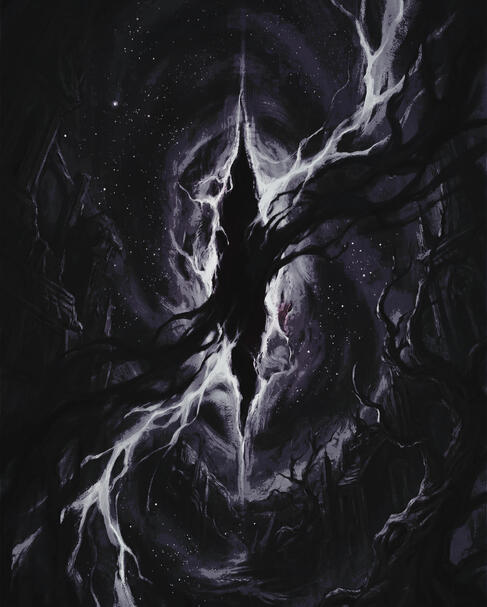
"Oh no, another victim of the vicious Black Mana. I have that miraculous medicine here, yes... it will be a thousand golden bars."
Those who come into contact with the presence of Necrosis do not simply risk their bodies or their minds. What is truly altered, often without their awareness, is the structure of the soul itself. In most belief systems, the soul is treated as something persistent, destined for an afterlife, whether it be reward, punishment, or continuation in another form. Under the influence of Necrosis, that assumption becomes incorrect.When an individual is deeply corrupted by Black Magic, reshaped through her “corrections,” or willingly aligns themselves with her principle, their soul begins to undergo a gradual simplification. At first, this change is subtle. The soul loses complexity in the same way the mind loses emotion or contradiction. It becomes more stable, more uniform, less burdened by identity or internal conflict. To the individual, this may even feel like clarity or relief, as if something unnecessary has been removed.However, this process does not stop at refinement.As the influence deepens, the soul is no longer preserved as an individual construct. It is reduced, stripped of the very qualities that define it as a unique existence. Memory, identity, emotional imprint, and continuity are all gradually erased, not violently, but with quiet precision. By the time physical death occurs, there is often nothing left that can be recognized as a “self” in the metaphysical sense.As a result, these souls do not pass into any afterlife. They are not judged, rewarded, or condemned. They do not linger, wander, or reincarnate. Instead, they undergo a final state that scholars and occultists struggle to even describe properly.They dissolve.Not into another realm, not into a collective, but into non-existence. It is not annihilation in the violent sense, but a complete erasure of structure, as if the soul was never formed to begin with. There is no consciousness to experience this, no awareness of loss, no transition. The individual does not “go” anywhere. They simply cease to be in a way that leaves no residue behind.This outcome is often misunderstood by those who study Necrosis. Some believe it to be a form of ultimate punishment, while others see it as a release from suffering. From her perspective, however, it is neither. It is simply the most efficient resolution of a flawed system. A soul, like any other structure, contains contradictions and instability. When fully subjected to her influence, those elements are removed until nothing remains that requires continuation.There are rare cases where individuals who only partially engage with her power retain enough structure to pass into an afterlife, though even then, they are often diminished, fragmented, or altered in ways that make them unrecognizable. But for those who fully embrace, wield, or are consumed by her presence, the outcome is consistent and absolute.In the end, they are not damned and they are not saved like how Necrosis' cults and priests claim.They are corrected to the point where existence is no longer necessary.
THE CORRUPTED MANA
What mortals call Black Magic does not originate from a school of study, a divine gift, or a hidden dimension. It originates from her. Not from her will in any intentional sense, but from the simple fact that Doctor Necrosis exists. Her presence is not confined to her avatar or her airship. It permeates reality as a subtle, invasive layer, like a stain that cannot be fully removed. Wherever existence begins to fracture, decay, or contradict itself, that presence becomes more pronounced, seeping into the world as a usable, albeit dangerous, force.This presence is not energy in the conventional sense. It does not flow like mana or respond cleanly to control. Instead, it behaves like a principle made tangible, something that rewards those who align with it and destabilizes those who do not. Mortals who access it are not drawing power from a source they understand. They are aligning themselves with a logic, one that favors reduction, domination, and the removal of complexity. The more closely a practitioner follows this logic, the more responsive the presence becomes, granting them abilities that appear as dark magic, curses, or forbidden arts.The use of this power always carries a cost, though not one immediately visible. Those who wield Black Magic begin to change, not just physically, but structurally. Their thoughts narrow, their emotions dull, and their sense of self begins to erode. This is not corruption in the moral sense, but realignment. The presence strips away internal contradictions, reshaping the individual into something more consistent with its nature. Over time, practitioners may lose the ability to feel empathy, doubt, or even fear, becoming increasingly efficient, increasingly detached, and increasingly inhuman.From this same presence, more extreme manifestations emerge. Demonic entities, aberrations, and other vile-aligned beings are not separate creations, but byproducts of prolonged exposure. In some cases, they are former mortals who have been reshaped beyond recognition, their identities collapsed into singular functions. In others, they are spontaneous formations, where the presence condenses into semi-stable forms within areas of intense instability. These entities often embody specific aspects of reduction or decay, acting as localized expressions of the same underlying principle that defines Necrosis.Such beings are frequently misinterpreted as servants or creations under her command. In reality, they operate independently, guided by instincts that mirror her logic but lack her precision. They spread, consume, and simplify in uncontrolled ways, often accelerating the collapse of the environments they inhabit. While their actions align with her nature, they are not directed by her. They are closer to symptoms than agents, evidence of her influence saturating a region beyond what it can contain.There are rare instances where individuals or cults manage to establish deeper connections with this presence, performing rituals that thin the boundary between themselves and its source. These acts can result in temporary surges of power, transformations, or the summoning of entities that appear more refined and controlled. However, even in these cases, the practitioners are not commanding the force. They are exposing themselves to it, allowing it to reshape them or their surroundings in exchange for the illusion of control.The spread of Black Magic across the world is therefore not the result of deliberate distribution, but of proximity and compatibility. Regions plagued by suffering, conflict, or decay become saturated with her presence, making it easier for individuals to access and utilize it. Over time, these areas become breeding grounds for cults, monsters, and phenomena that further reinforce the cycle, deepening the influence until it becomes a defining aspect of the region itself.Despite being the source of this power, Doctor Necrosis does not actively govern its use. She does not grant abilities, revoke them, or respond to those who call upon her through it. The connection is indirect, a consequence of what she is rather than something she chooses to provide. To her, Black Magic is not a gift or a weapon. It is simply an extension of her existence, a natural output of the same principle that drives her actions.In essence, her presence is the foundation upon which all dark power in the world is built. It is the reason such power exists, the reason it behaves as it does, and the reason it inevitably leads those who use it toward the same conclusion. Not through force, but through gradual alignment, until the individual no longer sees themselves as they once were, but as something simpler, quieter, and far closer to what Necrosis has always been.Where the presence of Necrosis settles deeply enough, Black Magic ceases to be something merely used and begins to act as an environmental condition, a slow, invasive blight that rewrites the land itself. It does not erupt violently at first. It seeps, saturates, and accumulates, turning entire regions into quiet incubators of distortion. The earliest signs are subtle: soil loses its natural scent, becoming dry or unnaturally slick, as if its structure has been simplified at a fundamental level. Nutrients no longer circulate properly. Microorganisms vanish or mutate into inert, unrecognizable forms. Crops fail not from drought or disease, but from a more absolute condition, as though the land has forgotten how to sustain life.As the influence deepens, the soil itself becomes hostile to natural growth. Seeds planted in such ground either refuse to sprout or produce aberrations that only vaguely resemble their original forms. Roots grow in unnatural patterns, spiraling inward or fusing together into dense, fibrous masses that pulse faintly beneath the surface. Flora exposed to prolonged saturation does not simply wither. It transforms. Trees split open along unnatural seams, their bark hardening into chitin-like textures, their branches bending into clawed structures that move with slow, deliberate intent. Flowers lose symmetry, their petals elongating into fleshy, grasping forms, often developing sensory functions, reacting to movement, heat, or sound.These transformed plants are not passive. They behave more like organisms driven by a singular directive, feeding, spreading, and simplifying their surroundings. Some release spores that carry the influence further, infecting nearby vegetation and accelerating the spread. Others anchor themselves deeply into the corrupted soil, acting as stabilizing nodes that intensify the presence of Black Magic in the area. What was once a forest becomes something else entirely, a living system of predation and control, where every element has been reduced to function without balance.Fauna does not escape this process. Animals that inhabit these regions undergo similar alterations, though often more violently. Their bodies adapt in ways that strip away unnecessary traits, enhancing specific functions while degrading others. Limbs may fuse or multiply, sensory organs sharpen or disappear entirely, and behavior narrows into rigid patterns. Predators become hyper-efficient, hunting without hesitation or excess movement. Prey species either evolve into equally specialized forms or collapse under the pressure, unable to adapt quickly enough. In many cases, the distinction between predator and prey dissolves, replaced by entities that exist solely to propagate the influence further.Entire ecosystems begin to collapse inward, losing the complexity that once sustained them. Diversity diminishes as dominant, simplified forms take over, creating environments that are eerily quiet and unnaturally ordered. There is no chaotic struggle for survival, only a gradual convergence toward stability through reduction. To an outside observer, these regions feel wrong in a way that is difficult to articulate. Sound is muted, movement is minimal, and life persists in a state that no longer resembles natural existence.Over time, these corrupted zones expand. The spread is not rapid in the way of fire or flood, but it is relentless. Each transformed area acts as a new source, extending the reach of Black Magic into neighboring lands. Borders between healthy and corrupted regions become unstable, with pockets of transformation appearing unpredictably, often far from the original source. Continents are not consumed in dramatic events, but through a slow, inevitable process, where more and more territory falls under the influence until entire regions become unrecognizable.Civilizations that border these zones often attempt to contain or cleanse them, but such efforts rarely succeed in the long term. Conventional methods fail because the blight is not purely physical. It exists on multiple levels, affecting not just the land, but the underlying structure of reality in those areas. Even if the visible corruption is removed, the conditions that allowed it to form remain, and the process begins again.
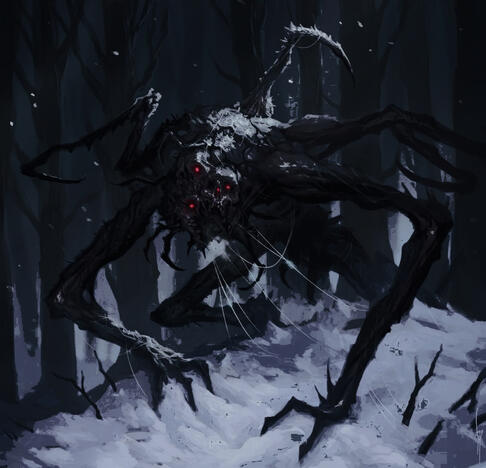
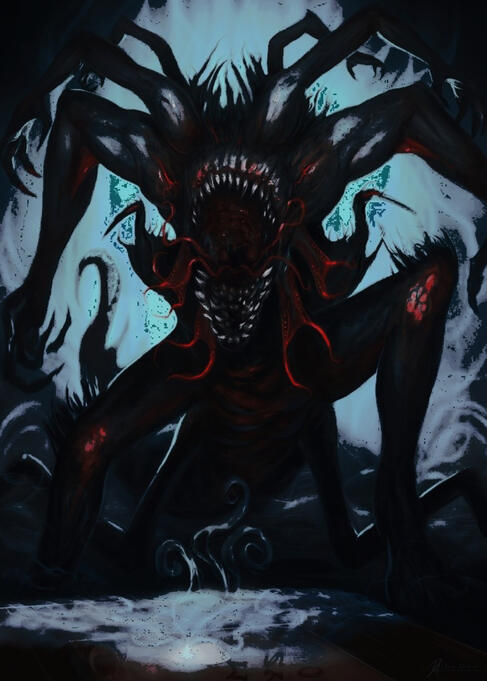
"Oh, I forgot you existed. Good work."
THRALLS
While most manifestations of Necrosis’s influence are indirect, there exist entities that stand apart from corrupted beasts or mindless abominations. These are not accidents of exposure, nor failed transformations. They are intentional extensions, beings shaped to carry out her principle across worlds with purpose and continuity. Known in scattered records as Thralls, Reclaimers, or simply the Hollow Host, they are the closest thing to true servants she possesses, though even this term is misleading. They do not worship her, nor are they commanded in any conventional sense. They exist because they have been perfectly aligned with her logic, their existence reduced to function without deviation.The origin of these Thralls is not singular. Some were once mortal, individuals who survived complete Taking and emerged as stable entities rather than hollow remnants. Others are constructed more deliberately, formed from combined biological, conceptual, and void-derived matter within her domain. A few are believed to be manifestations that never possessed individuality at all, born directly from regions saturated with her presence. Regardless of their origin, all Thralls share a defining trait: they are devoid of internal contradiction, making them incapable of disobedience or doubt.Physically, Thralls vary widely, but they follow a consistent design philosophy. Their forms are not meant to be aesthetically coherent, but functionally optimized. Limbs may be elongated for reach or speed, torsos compressed or expanded depending on their role, and sensory organs are either heightened to extreme degrees or removed entirely if deemed unnecessary. Many possess a dark, matte exterior that absorbs light, with faint internal glows that pulse in slow, deliberate rhythms. Their silhouettes often appear unstable, edges blurring or shifting as if they are not fully anchored to a single state of existence.Unlike the chaotic monsters spawned from uncontrolled corruption, Thralls operate with precision and coordination. They move in formations that adapt in real time, responding to changes in their environment without the need for communication. Each unit fulfills a specific role within a larger structure, whether it be direct assault, environmental destabilization, or the spread of influence. This makes them particularly dangerous in large numbers, as they do not behave like an army driven by morale or instinct, but like a system executing a process.When deployed upon a world, Thralls do not immediately seek to destroy it. Their actions follow a pattern that mirrors Necrosis’s broader methodology. They begin by identifying points of instability: political fractures, ecological weaknesses, or concentrations of power. These areas are targeted first, either through direct assault or through the introduction of engineered plagues and conceptual infections. As systems begin to fail, the Thralls advance, not to conquer in the traditional sense, but to simplify. Populations are reduced, structures dismantled, and environments reshaped until resistance becomes impossible.A defining aspect of their presence is their ability to convert. Much like Necrosis herself, Thralls can initiate localized forms of Taking, though on a more limited scale. Individuals who survive encounters with them may be partially or fully transformed, becoming new Thralls or lesser extensions. This allows their numbers to grow organically during campaigns, turning the very populations they target into components of the process. Over time, entire regions can be converted into self-sustaining systems that continue the work even in the absence of direct Thrall presence.At higher levels within their hierarchy exist entities that exhibit greater complexity, often referred to in fragmented texts as Harbingers or Executors. These beings retain a degree of adaptive intelligence, allowing them to coordinate large-scale operations across continents or even entire planets. They are capable of interpreting Necrosis’s underlying principle in more nuanced ways, adjusting strategies based on the unique conditions of each world. Despite this increased capability, they remain fundamentally aligned, incapable of deviating from the core logic that defines them.Encounters between Thralls and advanced civilizations rarely result in conventional warfare. Traditional tactics prove ineffective against an opponent that does not rely on morale, supply lines, or centralized command in the way mortal armies do. Even when defeated in isolated engagements, the Thralls’ influence lingers, as the conditions they create continue to degrade the world. Victory against them is often temporary, a delay rather than a resolution.Across the cosmos, there are records of worlds that have fallen entirely to their presence. These planets do not become wastelands in the usual sense. Instead, they are transformed into stable, silent systems, devoid of the complexity that once defined them. Life may still exist, but only in forms that serve a singular, unified function. In such places, the Thralls no longer need to act. The world itself has become an extension of Necrosis’s principle, requiring no further correction.In this way, the Thralls are not merely conquerors. They are the mechanism through which her influence becomes inevitable. Where they arrive, the process begins. Where the process begins, it does not stop.

"My ship still the coziest place of this rock."
Velkryss was once a tapestry of distinct peoples woven together by trade, conflict, and uneasy coexistence. Now, that tapestry is fraying, each thread pulling away as the world itself begins to distort what it means to belong to a race at all.The major races still persist in recognizable forms, though even that certainty is starting to erode. Humans remain the most widespread, adaptable to nearly any region, though also the most fractured, their kingdoms constantly rising and collapsing under internal conflict. Beastkin, like wolves, felines, and avians, once lived in tightly bound clans guided by instinct and tradition, but many of these structures have broken down. Some have integrated into human societies, while others have become isolationist, fiercely territorial, or even feral under prolonged exposure to corrupted lands. Elves, ancient and long-lived, were once seen as the keepers of knowledge and balance, but now many of them are either in decline or have turned toward extremes, some aligning with Black Magic in pursuit of control, others retreating into hidden sanctuaries to preserve what remains of their kind.Beyond them exist dwarven enclaves buried deep beneath the earth, where entire subterranean kingdoms have sealed themselves away from the surface, convinced that the world above is beyond saving. There are also less understood races, remnants of older ages or products of newer distortions, beings that blur the line between natural and unnatural existence. Some are stable enough to form societies. Others exist only on the edge of comprehension, appearing and disappearing as the world shifts around them.As these races struggle to survive, tensions between them have grown into something far more dangerous than simple prejudice. Racism in Velkryss is no longer just about culture or history. It is fueled by fear of corruption and change. When entire regions can twist living beings into something unrecognizable, the question of “what are you?” becomes far more than identity. It becomes a matter of survival. Accusations of contamination, hidden influence, or unnatural alignment have led to purges, forced segregation, and outright extermination campaigns. Entire communities have been destroyed not for what they are, but for what they might become.These tensions frequently erupt into civil wars, especially within human and mixed-race territories. Kingdoms fracture from within as factions argue over how to respond to the changing world. Some advocate for strict control and isolation, sealing borders and enforcing rigid laws to prevent the spread of corruption. Others push for the use of Black Magic as a necessary tool, believing that survival requires adaptation, no matter the cost. These ideological divides often lead to prolonged conflicts where the enemy is not another nation, but neighbors, former allies, or even family.All of these elements, the races, the growing hatred between them, the wars, the dungeons, and the beasts, are not isolated problems. They are symptoms of a deeper condition. Velkryss is a world losing its ability to maintain clear boundaries, between species, between nations, between what is natural and what is not.And as those boundaries continue to break down, the question is no longer how the races will coexist.It is whether the concept of “race” itself will survive what the world is becoming.
VELKRYSS
Velkryss is a world that was never meant to remain whole.In its earliest state, it was a place of balance, not in the peaceful sense, but in a fragile equilibrium where countless forces, natural and arcane, coexisted without fully consuming one another. Life thrived in complexity. Kingdoms rose and fell, magic flowed through structured systems, and the cycle of existence followed a pattern that, while imperfect, sustained itself. It was not a perfect world, but it was a stable one.That stability did not last.At some point beyond recorded history, something changed. Not a war, not a cataclysm in the traditional sense, but an intrusion at the very foundation of reality. The emergence of Necrosis was not witnessed as an event, but felt as a shift, subtle at first, then irreversible. The laws that governed existence began to loosen, and in the spaces where they weakened, something new took hold. Black Magic did not appear overnight. It seeped into the world, spreading through suffering, decay, and imbalance, until it became an undeniable force.From that moment forward, Velkryss ceased to be a closed system.The land itself began to change. Regions once fertile turned silent and lifeless, not destroyed, but simplified into something that could no longer sustain natural ecosystems. Other areas reacted differently, becoming unstable, overgrown, or violently unpredictable as opposing forces pushed back against the encroaching reduction. Entire continents now exist in varying states of transformation, some still resembling their original form, others completely overtaken by corruption or mutation.Civilizations adapted as best they could. Some attempted to preserve old knowledge, building fortified kingdoms and academies dedicated to understanding and controlling the new forces. Others embraced the changes, turning to Black Magic as a means of survival or dominance, often at great cost. Religions formed, fractured, and reformed, many centered around interpretations of Necrosis or the forces opposing her. Wars became more than conflicts over land or power, evolving into struggles over the very nature of existence itself.Amid this, Velkryss became a world of layered realities. In certain regions, the boundaries between physical, magical, and conceptual space have thinned, allowing phenomena that defy logic to manifest openly. There are places where time loops or fractures, where identity becomes unstable, and where the environment itself reacts to thought or presence. Travel across the world is no longer predictable, with routes shifting or disappearing entirely as the underlying structure changes.Above it all, or perhaps moving through it, the Tehom Airship drifts, a constant yet untraceable presence, appearing where the world is most unstable. Its existence is known in fragments, whispered about in stories, feared in regions that have seen its arrival. It is both a symbol and a warning, a sign that something far deeper than war or magic is at work.Despite everything, life continues.There are still cities untouched by major corruption, still people who live ordinary lives, still moments of beauty that persist even in a world that is slowly unraveling. But beneath that surface, the truth is unavoidable. Velkryss is not simply changing. It is being pulled in opposing directions, shaped by forces that do not belong to it and may not care if it survives.Necrosis continues her quiet, methodical influence, reducing complexity wherever it becomes inefficient. Aetherion ensures that nothing ever fully stabilizes, reintroducing chaos and growth in equal measure. Nyxara wages her wars openly, carving out dominion through conquest and consumption. Between them, the world is caught in a state that cannot resolve, unable to collapse, unable to stabilize.And within that tension, individuals like Ilyra Vance exist, small, fragile, and yet capable of disrupting the patterns that define everything else.Amid this chaos, dungeons have become a defining feature of the landscape. These are not simple ruins filled with treasure, but localized distortions of reality, places where the influence of Necrosis, Aetherion, or other unknown forces has concentrated into a stable anomaly. Some dungeons resemble ancient structures that have been overtaken and reshaped, their interiors shifting and expanding beyond physical limits. Others appear spontaneously, emerging from the ground or forming in abandoned regions. Within them exist creatures, artifacts, and phenomena that cannot be found anywhere else, making them both dangerous and highly sought after.Adventurers, mercenaries, and scholars are drawn to these dungeons despite the risks. They offer power, knowledge, and resources that cannot be obtained through normal means. However, they also serve as gateways for further corruption. Many who enter do not return. Those who do are often changed, sometimes subtly, sometimes irreversibly. Entire factions have formed around the exploration and exploitation of these spaces, turning them into battlegrounds where different groups compete for control.Mystical beasts roam the world as both relics of its original state and products of its ongoing transformation. Some are ancient creatures that have adapted to the changing environment, growing more dangerous and unpredictable over time. Others are newly formed, born from corrupted ecosystems or influenced by the same forces that shape dungeons. These beasts can range from territorial predators that dominate entire regions to wandering anomalies that appear without warning and disappear just as suddenly.In some cases, these creatures are revered or even worshipped, seen as embodiments of the world’s shifting nature. In others, they are hunted relentlessly, viewed as threats that must be eliminated before they spread further instability. There are even attempts to tame or weaponize them, though such efforts rarely end well.
— connections
Lieselotte — @ManaWhxre
Heavily Affiliated. Clinic portion co-worker, sex friend, .
Vaela — @MEDICVLENGINR
Exclusive. Laboratory assistant, sex friend.
Katherine — @UnbridledForce
Heavily Affiliated. Ship maid and general muscle.
affiliated characters & npcs
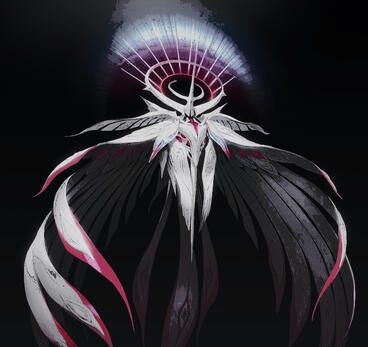
"You have forgot your place."
Aetherion
Aetherion is the primordial counterpart to Necrosis, born from the same instability at the beginning of existence. Where Necrosis represents reduction, correction, and the removal of all flaws, Aetherion embodies the opposite principle: endless expansion, contradiction, and uncontrolled growth. It exists to ensure that reality never reaches a final, stable state, preventing the “perfect silence” that Necrosis seeks.Its presence gives rise to forces that create rather than erase, though not in a benevolent way. Life touched by Aetherion becomes excessive and unstable, mutating, multiplying, or persisting beyond natural limits. Beings influenced by it may gain regeneration, duplication, or fragmented identities, becoming chaotic and difficult to destroy.Aetherion does not directly oppose Necrosis out of emotion or morality. It simply exists as a necessary counterbalance, ensuring that her process of correction can never fully complete. Where she simplifies, it complicates. Where she ends, it prolongs. Together, they form two opposing constants of reality: one that seeks conclusion, and one that ensures there is always something left unresolved.Aetherion’s influence does not spread in the same quiet, eroding way as Necrosis. It overflows. Where its presence takes hold, reality becomes saturated rather than stripped, producing environments that feel alive to an almost suffocating degree. Forests grow impossibly dense, roots intertwining into vast networks that pulse with shared life, while creatures multiply, mutate, and persist far beyond natural limits. Death becomes unreliable in these regions, not absent, but constantly undone, with beings returning in altered, fragmented, or duplicated states.Unlike the hollow stillness left behind by Necrosis, areas touched by Aetherion are loud, chaotic, and unpredictable. Identities fracture instead of disappearing. A single individual may develop multiple overlapping selves, each acting with partial autonomy, or exist in several physical forms at once. This does not grant clarity or enlightenment, but a kind of overwhelming existence where nothing is ever fully resolved. Even thought becomes crowded, layered with contradictions that never collapse into a single conclusion.Its followers, often called the Choir of Bloom, interpret this as a form of transcendence. They believe that perfection lies not in removing flaws, but in embracing endless variation, allowing existence to expand without limit. Their rituals focus on growth, duplication, and transformation, often resulting in beings that are beautiful and grotesque in equal measure. Unlike the cult of Necrosis, which seeks quiet and finality, Aetherion’s adherents celebrate excess, noise, and perpetual becoming.In the broader balance of the world, Aetherion acts as a constant disruption to Necrosis’s work. Where she reduces, it restores complexity. Where she creates silence, it reintroduces contradiction. However, this does not make it a force of salvation. Left unchecked, Aetherion’s influence would not preserve life as it is known, but distort it into something endlessly expanding and unrecognizable, a reality where nothing can end, and therefore nothing can truly exist in a stable form.Together, they ensure that the world is never allowed to settle into a single outcome. One pulls everything toward conclusion, while the other refuses to let anything conclude at all.
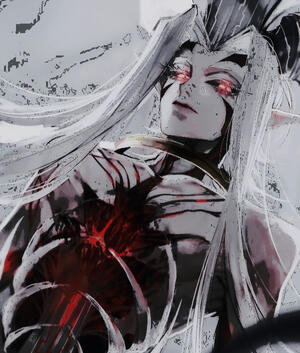
"I call it the sound of imperfection being removed."
Seraphel Vael’thir
Seraphel Vael’thir is recognized as the first true architect of what would become the Cult of the Final Cure, an ancient high elf whose life has stretched across millennia, sustained not by natural longevity alone, but by prolonged exposure to the very forces he came to worship. Once a scholar of arcane philosophy and metaphysical structures, Seraphel was among the earliest mortals to encounter traces of Necrosis’s presence and, more importantly, to interpret it not as a threat, but as a revelation.Over centuries of study, experimentation, and self-inflicted “refinement,” Seraphel abandoned traditional magic and morality, reshaping his body and mind through Black Magic rituals. He removed what he perceived as weaknesses—emotion, doubt, even fragments of his own identity—yet unlike most, he never fully collapsed into a hollow state. Instead, he exists in a rare, unstable balance: fanatically devoted, yet still capable of thought and direction, making him uniquely suited to lead others down the same path.As the founder, he did not create the belief itself, but he was the first to organize it into doctrine. He established its core teachings: that existence is flawed, that suffering is evidence of instability, and that through sacrifice and reduction, one may approach perfection. Under his guidance, scattered believers became structured sects, rituals were formalized, and the cult began to spread across regions and eventually continents.Despite his devotion, Seraphel has never been acknowledged by Necrosis in any direct or personal way. He is aware of this, yet it does not shake his faith. To him, her silence is not indifference, but confirmation. It proves that she does not need to guide or reward, because her truth is absolute. This belief has only deepened his fanaticism, driving him to escalate the scale of his actions in hopes of further aligning the world with her principle.Over the centuries, Seraphel has been linked to the fall of kingdoms, the rise of plague-based warfare, and the quiet manipulation of empires from within. He rarely acts openly, preferring to operate through disciples, rulers, and hidden networks. When he does appear, it is often at the center of major “corrections,” orchestrating events that reshape entire regions under the guise of inevitability.To his followers, he is a prophet, a living testament to the path of reduction. To his enemies, he is a relic that should not still exist. To Necrosis, however, he is something far simpler.A persistent variable that has yet to be removed.

"Look, I don’t ask what it is, I just make sure it doesn’t explode… unless it’s supposed to."
Rika “Patchwork” Vell
Rika Vell is the kind of person who should not, by any reasonable standard, be allowed anywhere near something like the Tehom Airship. Unfortunately for the world, she is also the only one who can keep it running.A human engineer of questionable ethics and exceptional talent, Rika stumbled into Necrosis’s orbit not through devotion, fear, or destiny, but through a contract. She was originally a scavenger and mechanic in the Wastelands, known for repairing relic-grade machinery that most considered unsalvageable. When the Tehom Airship first manifested in a damaged, partially destabilized state after an unknown event, Rika was one of the few who didn’t run.Rika is fully aware of what Necrosis is. Not in the abstract, mythological sense, but in the practical, horrifying reality of it. She has seen the “patients,” the procedures, the Thralls, and the way the airship itself bends reality like it’s optional. She understands that her employer is not a person, not really, and certainly not something that should be bargained with.She simply does not care.As long as she gets paid.Payment, in her case, rarely comes in coin. Necrosis compensates her with access to impossible materials, knowledge that breaks conventional physics, and the freedom to experiment without limitation. For Rika, this is more valuable than any currency. The Tehom Airship is less a job and more a playground, a constantly shifting machine that challenges her skills in ways nothing else ever could.Her personality stands in stark contrast to everything around her. Where Necrosis is silent and clinical, Rika is loud, sarcastic, and endlessly irreverent. She cracks jokes in operating halls, gives nicknames to eldritch constructs, and treats reality-warping anomalies like minor inconveniences. This makes her both unsettling and oddly grounding, as she navigates horrors that would break most minds with casual ease.Physically, Rika is often seen covered in grease, soot, or some unidentifiable residue from her latest “fix.” Her outfit is a chaotic mix of tools, straps, and modified gear, all designed for mobility and utility. She carries custom instruments that blur the line between engineering tools and arcane devices, allowing her to interact with both the mechanical and conceptual aspects of the airship.Her role aboard the Tehom Airship goes far beyond maintenance. She is responsible for stabilizing its shifting structure, repairing damage that doesn’t follow normal rules, and occasionally modifying its systems to improve efficiency. This includes adjusting how rooms manifest, reinforcing areas where reality begins to thin too much, and even integrating new “features” based on her own ideas. Some of these modifications have been quietly approved by Necrosis. Others have simply not been stopped.

"If it bleeds, it fights. If it fights, I’m interested."
Kaien “Red Fang” Shirogane
Kaien Shirogane was the first to stand at the edge of the Tehom Airship not as a patient, not as prey, but as something closer to a contract given flesh. A renegade beastkin swordsman from a Far Eastern clan long since erased from history, Kaien carved his name into battlefields before ever crossing paths with Necrosis. Born into a lineage that revered discipline and tradition, he abandoned both the moment he realized that war, not honor, was the only truth that remained consistent. His exile was not forced. He walked away willingly, leaving behind titles, loyalty, and identity, keeping only the blade and the instinct to use it.By the time he encountered Necrosis, Kaien had already become something of a myth, a mercenary whose presence guaranteed bloodshed. He did not fight for causes, ideologies, or nations. He fought because combat was the only state in which he felt something resembling purpose. When he first boarded the Tehom Airship, it was not out of curiosity or desperation, but opportunity. He recognized immediately that whatever resided within that vessel was not human, not natural, and not something he could fully understand. His response was simple.If it paid, it was worth the risk.Necrosis, in turn, recognized in Kaien a rare kind of utility. Unlike most mortals, he did not hesitate, question, or collapse under the weight of her presence. His mind was already stripped down in its own way, not through her influence, but through years of combat that had reduced his world into a series of engagements, outcomes, and survival. He was not aligned with her, but he was compatible enough to remain intact.Physically, Kaien embodies controlled violence. His beastkin traits, marked by sharp ears, predatory eyes, and enhanced reflexes, are complemented by a body honed through constant battle. His armor is minimal, designed for movement rather than protection, often stained and marked from countless encounters. His weapon of choice is a long, curved blade from his homeland, though it has been modified over time, its structure subtly altered by exposure to the Tehom Airship’s influence. The blade itself feels wrong to those who sense it, as if it cuts more than just flesh.As the first armed guard of the airship, Kaien’s role was simple but essential. He ensured that those who entered did so on Necrosis’s terms, and that those who attempted to leave without permission did not succeed. Beyond this, he acted as her external instrument, carrying out assassinations, eliminations, and targeted strikes across regions where subtlety was no longer sufficient. Unlike the Thralls, Kaien operates independently, capable of adapting, improvising, and pursuing targets with a level of precision that no constructed entity could replicate.His personality is direct, blunt, and almost dismissive. He does not engage in philosophy, nor does he concern himself with the implications of Necrosis’s existence. To him, she is simply the most consistent employer he has ever had. There is no deception, no shifting loyalties, and no moral complications. She provides a target. He removes it. The transaction is clean.Despite his apparent simplicity, there is a depth to Kaien’s mindset that sets him apart from ordinary mercenaries. He does not seek victory in the traditional sense. He seeks conflict itself, valuing opponents who push him to the edge of his limits. This makes him particularly dangerous, as he will often prolong engagements, testing and adapting rather than ending them immediately. In some cases, he has even allowed targets to escape temporarily, only to pursue them later once they have grown stronger.His relationship with Necrosis is one of mutual functionality. She does not control him, and he does not serve out of loyalty. Yet, she has never attempted to Take him, nor has she replaced him with something more obedient. Whether this is due to his effectiveness, his unique mental state, or a calculated decision remains unclear.

"Why erase a world… when you can make it kneel?"
Nyxara, Sovereign of the Bleeding Abyss
(also called: The Crimson Matron, Queen of Ruin, Mother of Endless Hunger)Nyxara is what happens when a world tries to create its own answer to extinction… and fails.Long before she became a queen, Nyxara was not a single being, but a convergence. In an age where Black Magic had already begun to stain the world, entire civilizations turned to forbidden rituals in desperation, seeking power to resist collapse, to rival gods, or to dominate their enemies. What they summoned was not control, but accumulation. Countless sacrifices, demonic entities, and fractured souls were bound together in a single catastrophic event, birthing something that should not have stabilized.Nyxara was the result.Unlike the Thralls or corrupted beasts, Nyxara retained identity, will, and ambition. She did not emerge hollow. She emerged hungry. Where Necrosis reduces and Aetherion expands, Nyxara consumes and exalts, building herself upward from everything she devours. She is not a principle like them, but she is dangerously close to becoming one.Nyxara is a being defined not by balance or restraint, but by overwhelming presence, the kind that fills a room before she even steps into it. She is not subtle, not hidden, and never mistaken for anything less than what she is. Where other forces in the world operate through quiet influence or distant inevitability, Nyxara stands at the center of events, shaping them through force of will, conquest, and sheer dominance. She carries herself like a ruler who has never known defeat, and in many ways, that belief has become reality through repetition. Every victory reinforces her identity, every conquest adds to the weight of her existence, until she has become something that feels less like a person and more like a living empire.Her personality is intense, vivid, and unapologetically excessive. She feels everything in extremes and expresses it without hesitation. Pride is not a flaw to her, but a foundation. Anger is not a loss of control, but a weapon. Desire is not something to suppress, but something to indulge and weaponize. She does not hide her emotions because they are not weaknesses in her eyes, they are proof that she exists fully, in contrast to the hollow or fragmented beings shaped by other forces. This makes her dangerously charismatic. People do not just fear her, they are drawn to her, pulled in by the raw certainty she projects. Even those who oppose her often find themselves captivated, if only for a moment, by the clarity of her purpose.Nyxara’s intelligence is often underestimated because of her brutality, but that is a mistake few survive. She understands power not just as strength, but as structure. She knows when to crush resistance and when to let it grow, when to destroy and when to absorb. Her empire is not built on chaos alone, but on a calculated balance of fear, reward, and control. She allows ambition within her ranks, but only to a point, ensuring that those who rise do so under her shadow, never beyond it. Betrayal is common in her domain, but it is also expected, and often encouraged, as it sharpens those who survive and removes those who are unworthy.What truly defines Nyxara, however, is her relationship with consumption. She does not simply kill or conquer. She takes. Every enemy defeated, every soul claimed, every fragment of power seized becomes part of her in a very literal sense. This accumulation shapes her constantly, layering new aspects onto her identity without ever fully replacing what came before. She is not a static being, but an ever-growing one, a convergence of countless lives, wills, and powers that she has absorbed over time. And yet, unlike the chaotic overflow of something like Aetherion, Nyxara maintains control over this accumulation, forcing it into a singular, dominant self. She is many, but she is also one, and that unity is what makes her so dangerous.Despite her overwhelming nature, Nyxara is not without awareness of the larger forces at play. She understands, at least partially, that there are entities and principles beyond her, things that do not operate on the same level as her wars and conquests. Necrosis, in particular, represents something she cannot simply dominate or consume, and that reality frustrates her in a way nothing else does. It is not fear that drives her opposition, but refusal. She will not accept a world where everything she has built, everything she has become, is reduced to nothing. That defiance becomes one of her strongest traits, a refusal to yield not just to enemies, but to the very idea of an ending she cannot control.In the end, Nyxara is not a force of balance or inevitability. She is will made manifest, the desire to exist loudly, powerfully, and without limit. If Necrosis is the quiet end of all things, then Nyxara is the roaring refusal to go quietly, a queen who would rather burn the world in her image than allow it to fade into silence.

"I don’t need to win against the end of the world… I just need to not become it."
lyra Vance, the Unfinished
Ilyra Vance was never meant to matter.She was not born into power, prophecy, or legacy. No divine mark, no ancient lineage, no hidden inheritance waiting to awaken. She began as something painfully ordinary, a survivor of a region slowly consumed by the creeping influence of Black Magic, where the land itself had begun to fail and people vanished into things they no longer recognized. Like many others, she was exposed. Like many others, she should have changed.But she didn’t.Or rather, she did… incompletely.Ilyra is what happens when the forces of this world attempt to claim someone and fail to finish the process. She carries traces of Necrosis’s influence within her, but not enough to erase her identity. At the same time, something else lingers, a faint, unstable resistance that prevents full reduction. The result is a person who exists in a fragile, shifting balance, someone who can feel the pull of becoming something less… and refuses it every time.This makes her unique, not because she is stronger than the forces around her, but because she is unfinished in a way that cannot be easily resolved.Her personality reflects that tension. Ilyra is grounded, pragmatic, and often exhausted, someone who has seen enough of the world to understand how little control anyone truly has. She does not speak in grand ideals or heroic declarations. She doubts, hesitates, and questions constantly, but she continues forward anyway. What sets her apart is not unwavering confidence, but persistence. Where others break, convert, or submit, she endures, even when there is no clear reason to believe things will improve.She feels fear. She feels anger. She feels grief.And she chooses to keep going with all of it intact.That alone makes her an anomaly in a world shaped by forces that either strip emotion away or overwhelm it entirely.Ilyra’s abilities are not overwhelming, but they are deeply disruptive to the systems around her. She can resist forms of corruption that would normally take hold instantly, and in some cases, she can interfere with them in others, slowing or destabilizing processes that should be absolute. Against Thralls, her presence introduces inconsistency, breaking their perfect coordination. Within corrupted zones, she can move where others cannot, as the environment struggles to fully “process” her existence. Even encounters with entities tied to Necrosis or Aetherion become unpredictable, as neither force can fully claim or categorize her.This does not make her invincible. In fact, it often makes her more vulnerable. She lacks the overwhelming power of beings like Nyxara, and she cannot rely on systems or magic that demand full alignment. Every fight is a risk. Every encounter pushes her closer to either being fully taken or completely overwhelmed. There is no stable ground for her to stand on, only constant resistance.Her role in the world is not to defeat Necrosis or Aetherion outright, because such things may not even be possible. Instead, she represents something far more fragile and, in its own way, more dangerous.She represents the refusal to resolve.Where Necrosis seeks to simplify and conclude, Ilyra remains complex. Where Aetherion seeks endless expansion, she maintains a singular self. Where Nyxara consumes and dominates, Ilyra resists being defined by what she faces. She does not embody a cosmic principle. She embodies something smaller, but far more stubborn.Choice.That makes her a problem for everything.To Necrosis, she is an inefficiency that refuses correction.
To Aetherion, she is a limitation that resists expansion.
To Nyxara, she is a defiance that cannot be broken or absorbed cleanly.She is not the strongest being in this world.She is the one thing that does not fit.And because of that, she might be the only one capable of changing anything at all.